

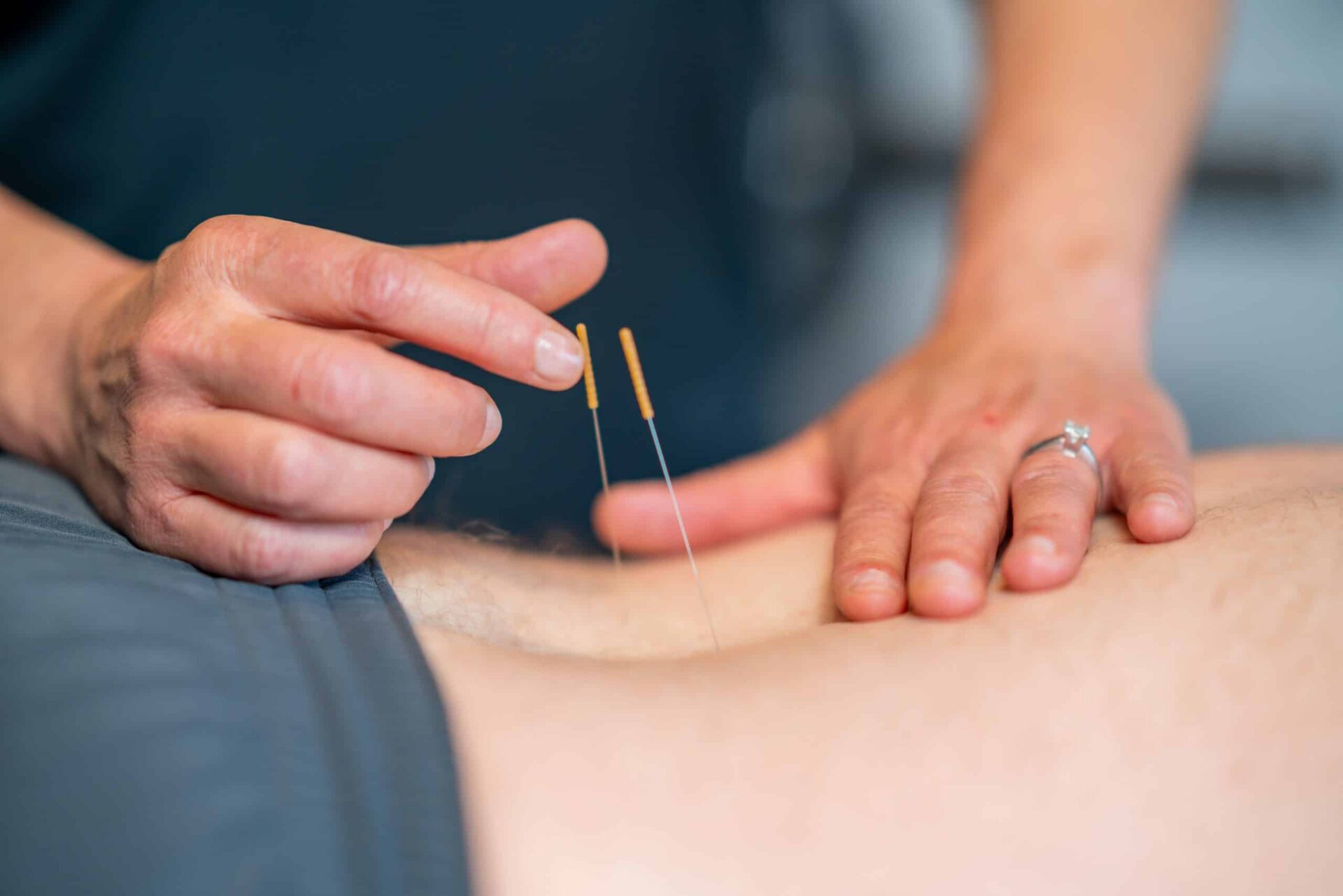
Your physiotherapist suggests “needling” for the tight, aching muscle in your lower back that just won’t let go. You nod along, then realise you’re not sure what that means. Is it acupuncture? Dry needling? What’s IMS? A friend swears by one; your coworker says another one “hurt like crazy but fixed everything.”
It’s a question we hear all the time. All three treatments use the same kind of hair-thin needle, so from the outside they look almost identical. But they’re built on different ideas, target different problems and feel quite different on the table. Knowing the difference helps you understand what’s being recommended and why.
This guide walks through what each one is, how they compare, and how to tell which might suit your pain. At Riverwood Physio in Port Coquitlam, our physiotherapists use both acupuncture and IMS, so we explain this every week.
The Short Answer
Acupuncture places several needles and leaves them in for 10 to 15 minutes to calm pain and support healing. Dry needling targets tight, tender trigger points in muscle. IMS is a specific dry needling system, developed in Vancouver, that treats muscle tightness caused by irritated nerves, with each needle in and out within seconds. Acupuncture tends to feel gentler; dry needling and IMS go straight into the problem muscle and usually feel more intense, often with a quick twitch as the muscle releases.
The rest of this post unpacks the details, including when each tends to work best.
What Is Acupuncture?
Acupuncture involves inserting thin, sterile needles at specific points on the body and leaving them in place for a period of time, usually 10 to 15 minutes.
There are two broad ways of practicing it:
- Traditional Chinese Medicine (TCM) acupuncture is thousands of years old. It’s based on the idea that energy (qi) flows along pathways called meridians, and that restoring that flow improves health. In BC, TCM acupuncture is provided by registered acupuncturists (R.Ac) and TCM practitioners, and it’s often used for a wide range of concerns beyond pain, including stress, sleep and digestion.
- Western medical acupuncture uses many of the same points but explains the effects through modern physiology. Needling stimulates the nervous system to release the body’s natural pain relievers, such as endorphins, and increases local blood flow, which brings oxygen and nutrients to support healing. This is the approach physiotherapists use, with a focus on pain, injury and movement.
Research supports acupuncture for several common musculoskeletal problems, including low back pain, neck pain, knee osteoarthritis and headaches. It’s usually one part of a broader treatment plan rather than a standalone fix.
What it feels like: most people feel very little as the needle goes in, followed by mild pressure, tingling or a dull ache. Many patients find it relaxing enough to doze off.
What Is Dry Needling?
Dry needling is a Western technique that targets myofascial trigger points: the tight, tender knots in a muscle that can cause local pain and pain that refers elsewhere. “Dry” simply means nothing is injected. The needle itself is the treatment.
The practitioner feels for the trigger point, inserts a needle directly into it and often moves it gently to provoke a local twitch response, a quick involuntary contraction. That twitch is a sign the muscle is releasing. Needles may be left briefly or removed right away, depending on the technique.
Dry needling is based on anatomy and neurophysiology, not meridians. It’s commonly used for muscle-driven pain such as neck and shoulder tension, sports strains and overuse injuries.
What it feels like: a deep ache or cramp-like sensation when the needle hits the trigger point, sometimes with that twitch. Muscles can feel sore for a day or so afterwards, much like after a hard workout.
What Is IMS?
Intramuscular stimulation (IMS) is a specific, trademarked system of dry needling developed in Vancouver in 1973 by Dr. Chan Gunn. It’s a local innovation that’s now used around the world.
Dr. Gunn noticed that some injuries didn’t recover on the usual timeline, and that many of these stubborn cases had a nerve component. His theory: when a nerve, often at the spine, becomes irritated, it becomes hypersensitive and the muscles it supplies become tight, shortened and painful. This is known as neuropathic pain. Stretching, massage and rest may give short-term relief, but the muscles keep tightening back up because the underlying nerve irritation is still there.
IMS treats this by needling the shortened muscles, often including the small muscles alongside the spine near the affected nerve root, to release them and reduce the sensitivity driving the problem. What separates IMS from general dry needling is the assessment: practitioners are trained to look for physical signs of nerve involvement and to treat along the nerve pathway, not just the spot that hurts.
What it feels like: one needle at a time, in and out within seconds. When it reaches a tight muscle, you’ll often feel a strong grab or twitch, followed by a deep ache that fades quickly. Soreness can last 24 to 48 hours; heat usually helps. Many people feel looser and move more easily soon after.
Side-by-Side: The Real Differences
| Acupuncture | Dry needling | IMS | |
| Based on | TCM meridians, or modern physiology (Western approach) | Anatomy and trigger point theory | Dr. Gunn’s model of nerve-related (neuropathic) pain |
| Where needles go | Specific acupuncture points, often near the painful area | Directly into trigger points in the muscle | Into shortened muscles, often including muscles beside the spine |
| How long needles stay in | 10 to 15 minutes | Seconds to a few minutes | Seconds |
| Number of needles | Several at once | Varies | One at a time |
| How it feels | Mild pressure or dull ache; often relaxing | Deep ache, twitch response | Strong grab or twitch, deep ache |
| Afterwards | Little to no soreness | Possible soreness for about a day | Possible soreness for 24 to 48 hours |
| Often used for | Osteoarthritis, headaches, acute strains, inflammation, general pain relief | Muscle knots, tension, sports strains | Chronic tightness, sciatica, nerve-related and long-standing pain |
The simplest way to think about it: acupuncture turns down the volume on pain; dry needling and IMS go in and reset the muscle. IMS goes one step further by also targeting the nerve irritation behind the tightness.
Which One Is Right for You?
In practice, you don’t need to pick. A good physiotherapist will assess you and recommend the approach that fits, and may use more than one over the course of your treatment. That said, here are some general patterns.
Acupuncture is often a good fit when:
- You have a recent strain, sprain or flare-up with inflammation.
- You’re managing osteoarthritis in the knee, hip or hands.
- You get recurring tension headaches.
- You’re sensitive to discomfort and want a gentler option.
Dry needling or IMS is often a good fit when:
- A muscle feels permanently tight and hasn’t responded to stretching, massage or rest.
- You have sciatica or pain that travels down an arm or leg.
- Your pain has lasted months, keeps coming back or feels “deeper” than a normal muscle ache.
- You have specific, tender knots that reproduce your pain when pressed.
Real-world examples: You tweaked your back lifting a box last week and it’s inflamed and sore; acupuncture can help calm things down while you start moving again. You’ve had a tight, aching hip and buttock for six months, with pain that sometimes shoots down your leg; IMS is often worth considering. You have a knot under your shoulder blade that flares after long days at your desk; dry needling or IMS can release it quickly.
Whichever one is used, needling works best alongside hands-on treatment and exercise. The needles create a window of less pain and better movement, and the exercises help you keep it. If you’re still deciding whether physio or massage is the right starting point in the first place, our post on physio vs. massage therapy walks through that decision.
Who Can Provide Them in BC?
This is where the differences matter in practice.
- TCM acupuncture is provided by registered acupuncturists and TCM practitioners.
- Acupuncture and dry needling by physiotherapists require additional post-graduate training beyond a physiotherapy degree. Not every physiotherapist has it.
- IMS requires its own specialised certification, which is longer and more demanding than general dry needling courses. That’s why fewer clinics offer it, even though it was developed right here in the Lower Mainland.
If you’re specifically interested in IMS, ask the clinic whether their practitioner is trained in it rather than general dry needling. The terms are often used interchangeably, but the training and assessment behind them are not the same.
Is Needling Safe?
When performed by a trained practitioner using sterile, single-use needles, acupuncture, dry needling and IMS are all very safe. The most common side effects are minor bruising, a small spot of bleeding or temporary soreness. Less commonly, some people feel faint or have a short-term increase in symptoms.
Needling isn’t right for everyone. Your practitioner should screen you before treatment and may avoid or modify needling if you:
- Are pregnant
- Take blood thinners or have a bleeding disorder
- Have a weakened immune system
- Have an infection or broken skin over the treatment area
Always mention any health changes or medications before your session.
What About Insurance?
When acupuncture or IMS is performed by a physiotherapist as part of your treatment, it falls under your physiotherapy benefits. TCM acupuncture from a registered acupuncturist is usually claimed under a separate acupuncture category. Every plan is different, so check your benefits booklet or call your provider if you’re unsure.
After a car accident, needling can be part of your physiotherapy care under your ICBC claim if your physiotherapist feels it’s appropriate. No doctor’s referral is needed to book.
Acupuncture and IMS at Riverwood
At Riverwood, acupuncture and IMS are performed by physiotherapists with post-graduate needling training, as part of a full treatment plan. That means every session starts with an assessment of what’s actually causing your pain, and needling is combined with manual therapy and exercise when it helps.
We see patients from across the Tri-Cities, including many who come over from Coquitlam for our acupuncture and IMS services. Our clinic is in Fremont Village in Port Coquitlam, with free parking, evening and weekend hours, and direct billing to most extended health plans, ICBC and WorkSafeBC.
You can read more on our acupuncture therapy and IMS treatment pages.
Not Sure Which One You Need?
If you remember one thing from this post: acupuncture is generally gentler and great for calming pain and inflammation, while dry needling and IMS go directly into tight, stubborn muscles, with IMS also targeting the nerve irritation behind them. You don’t have to choose on your own. A physiotherapy assessment will tell you whether needling makes sense for you, and which type.
Book a physiotherapy assessment and ask your physiotherapist whether acupuncture or IMS could help.
Frequently Asked Questions
Is dry needling the same as IMS?
IMS is a type of dry needling, but not all dry needling is IMS. General dry needling targets trigger points in a muscle. IMS is a specific system developed by Dr. Chan Gunn that also treats nerve-related muscle tightness, often by needling muscles near the spine, and requires its own certification.
Is dry needling the same as acupuncture?
No. Both use the same type of thin needle, but acupuncture places needles at specific points and leaves them in for 10 to 15 minutes, while dry needling goes directly into tight trigger points in muscle, usually for a much shorter time. They’re based on different theories and feel different.
Which hurts more, acupuncture or IMS?
IMS is usually more intense. Acupuncture typically causes only mild pressure or a dull ache. With IMS, a tight muscle often grabs the needle or twitches, which can feel like a strong, deep cramp for a moment. The discomfort passes quickly, though some soreness can last a day or two.
Can acupuncture and IMS be used in the same session?
Yes. Some patients benefit from both, for example IMS to release a tight muscle and acupuncture to calm pain in a nearby area. Your physiotherapist will decide what makes sense based on your assessment.
How many sessions will I need?
It depends on the problem and how long you’ve had it. Some people notice a change after one or two sessions. Long-standing pain usually needs more, and results last longer when needling is paired with exercise.
Do I need a referral for acupuncture or IMS?
Not to see a physiotherapist in BC. Some extended health plans ask for a doctor’s note for reimbursement, so it’s worth checking your plan.
What should I wear to a needling appointment?
Comfortable clothing that gives easy access to the area being treated, such as shorts for the legs or hips, or a tank top for the neck and shoulders.